Su última visita fue: Vie Abr 29, 2016 2:14 pm Fecha actual Vie Abr 29, 2016 2:14 pm

Todos los horarios son UTC + 1 hora [ DST ]


 [ 205 mensajes ]  Ir a página Previo  1 ... 9, 10, 11, 12, 13, 14  Siguiente
Autor Mensaje
 Asunto: Re: Stalin y el culto a la personalidad
NotaPublicado: Mié Abr 08, 2015 10:57 am 
Conectado
trotsky was right y lo sabes
Avatar de Usuario

Registrado: Mié Dic 24, 2014 3:41 pm
Mensajes: 3370
Ubicación: Washington D.C.
Neck, desgraciadamente ahora no puede atenderte. Pero te prometo que luego te prestaré atención, tal como te mereces.

Un placer verte convertido en el nuevo Karel.

Sigue chupando, que yo te aviso.

_________________
Imagen


Arriba
 Perfil Email  
 
 Asunto: Re: Stalin y el culto a la personalidad
NotaPublicado: Mié Abr 08, 2015 11:05 am 
Desconectado
Ahí, dándolo todo
Avatar de Usuario

Registrado: Mar Nov 20, 2007 1:39 pm
Mensajes: 39930
Ubicación: Barcelona
Señor Gurb, limítese, porfa, a editar las alusiones inconvenientes y respete el resto del texto. Gracias.

Señor Neck. Se le tiene por persona ingeniosa y divertida. Invente otra pulla. No desmerezca su nivel.

_________________
Imagen


Arriba
 Perfil  
 
 Asunto: Re: Stalin y el culto a la personalidad
NotaPublicado: Mié Abr 08, 2015 11:06 am 
Conectado
trotsky was right y lo sabes
Avatar de Usuario

Registrado: Mié Dic 24, 2014 3:41 pm
Mensajes: 3370
Ubicación: Washington D.C.
Oído cocina.

_________________
Imagen


Arriba
 Perfil Email  
 
 Asunto: Re: Stalin y el culto a la personalidad
NotaPublicado: Mié Abr 08, 2015 11:07 am 
Desconectado
Demasiado patriota
Avatar de Usuario

Registrado: Mar Ene 08, 2008 10:17 am
Mensajes: 19198
Ubicación: La Antiespaña
EDITADO

_________________
Imagen
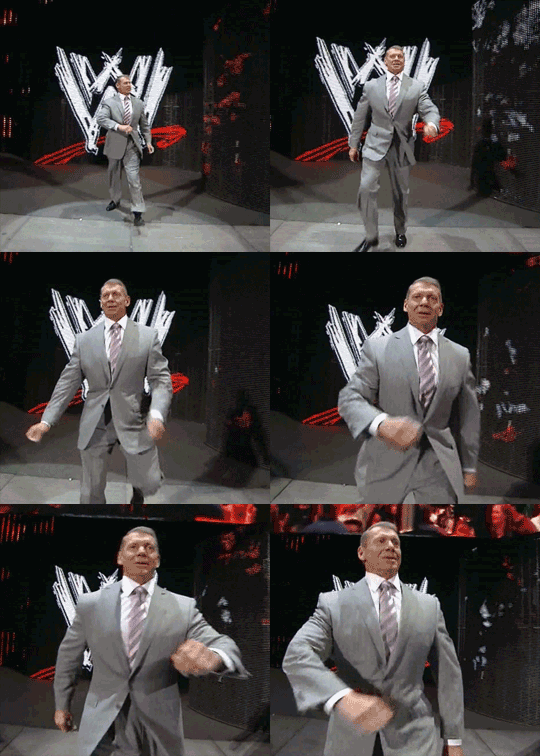
Éste soy yo, entrando en el hilo que has abierto, a leer todos y cada uno de tus posts:
Imagen
http://i46.tinypic.com/30dfdxy.jpg
http://i46.tinypic.com/34pcio5.jpg


Arriba
 Perfil  
 
 Asunto: Re: Stalin y el culto a la personalidad
NotaPublicado: Mié Abr 08, 2015 11:08 am 
Conectado
trotsky was right y lo sabes
Avatar de Usuario

Registrado: Mié Dic 24, 2014 3:41 pm
Mensajes: 3370
Ubicación: Washington D.C.
Orden cumplida.

_________________
Imagen


Arriba
 Perfil Email  
 
 Asunto: Re: Stalin y el culto a la personalidad
NotaPublicado: Mié Abr 08, 2015 11:09 am 
Desconectado
Demasiado patriota
Avatar de Usuario

Registrado: Mar Ene 08, 2008 10:17 am
Mensajes: 19198
Ubicación: La Antiespaña
ESTALIN EDITADO

_________________
Imagen
Éste soy yo, entrando en el hilo que has abierto, a leer todos y cada uno de tus posts:
Imagen
http://i46.tinypic.com/30dfdxy.jpg
http://i46.tinypic.com/34pcio5.jpg


Arriba
 Perfil  
 
 Asunto: Re: Stalin y el culto a la personalidad
NotaPublicado: Mié Abr 08, 2015 11:51 am 
Desconectado
We are not done yet!

Registrado: Mar May 30, 2006 1:18 pm
Mensajes: 56575
Ubicación: I will show YOU the Dark Side
Del libro de Arch Getty, "Las Grandes Purgas del Partido Comunista Soviético reconsideradas".

Citar:
When in 1938
Stalin criticized the cult of personality, it was necessary to suppress his
remarks. In a letter to a minor publishing house, Stalin advised against
the publication of a hagiographical Stories About Stalin's Childhood:
The book abounds in a mass of factual improbabilities, alterations, and unearned
praise. The author is led astray by lovers of fables, by impostors (even
by impostors "in good faith"), by flatterers. . .the book tends to instill. . .the
cult of personalities, of leaders, of infallible heroes. This is dangerous and
harmful. The theory of "heroes" and masses is not a Bolshevist theory. .
.1
recommend burning the book.8
His denunciations of the "cult of personalities" can be understood
as simple assertions of the well-known modesty of the supreme leader.
But if that were all that was involved, it is hard to understand why the
letter was not released or published until after the dictator's death.
More likely, statements condemning the cult of Stalin from the leader
himself were too subversive to the regime's operating principles and
norms to be published in the thirties.9

Curiously, Leon Trotsky had put his finger on the issue in a particularly
lucid analysis of Stalin's role. In arguing that Stalin's personality
was not crucial in its own right, Trotsky noted that Stalin was the front
man, the symbol, of the bureaucracy. In Trotsky's view, Stalin did not
create the bureaucracy but vice versa. Stalin was a manifestation of a
bureaucratic social phenomenon: "Stalin is the personification of the
bureaucracy. That is the substance of the political personality."10
Yet Western scholars have remained hypnotized by Stalin's cult of
personality, and their obsession with him has led to studies of the Great
Purges period that provide no detailed investigation of the political, institutional,
and structural milieu of the phenomena. Rather than placing
events in these contexts, scholars have often discussed the Great
Purges only against the background of Stalin's personality and categorized
Stalinism simply as the undisputed rule of an omniscient and omnipotent
dictator. Contradictions and confusion are seen as manifestations
of Stalin's caprice, and too often the political history of the Stalin
period has merely been the story of Stalin's supposed activities. An understanding of the thirties based on Stalin's personality is as limiting
and incomplete as an explanation of Nazism derived primarily from
Hitler's psyche
.

It is not necessary for us to put Stalin in day-to-day control of events
to judge him. A chaotic local bureaucracy, a quasi-feudal network of
politicians accustomed to arresting people, and a set of perhaps insoluble
political and social problems created an atmosphere conducive to
violence.
All it took from Stalin were catalytic and probably ad hoc interventions
at three pivotal points - early 1936 (to reopen the Kirov investigation),
November 1936 (to condemn Piatakov),and June 1937
(to unleash Ezhov) - to spark an uncontrolled explosion. That he did
so intervene speaks for itself.
Actually, the question of Stalin's role as planner was - or should have
been - a secondary one in this analysis, which has, rather, tried to show
that the party before World War II was a certain type of disorganized
and cumbersome machine. The existence of high-level personal rivalries,
disputes over development or modernization plans, powerful and
conflicting centrifugal and centripetal forces, and local conflicts made
large-scale political violence possible and even likely.

The evidence suggests that the Ezhovshchina - which is what most
people really mean by the "Great Purges" - should be redefined. It
was not the result of a petrified bureaucracy's stamping out dissent and
annihilating old radical revolutionaries. In fact, it may have been just
the opposite. It is not inconsistent with the evidence to argue that the
Ezhovshchina was rather a radical, even hysterical, reaction to bureaucracy.
The entrenched officeholders were destroyed from above and below
in a chaotic wave of voluntarism and revolutionary puritanism.

The radicalism of the thirties did not last. Although ritualized kritika/
samokritika became a regular part of party practice, it would never again
have the impact it did in 1937. Although politics in the thirties was often
populist and even subversive, the exigencies of World War II combined
with the practical demands of running an increasingly
complicated economy meant that radicalism and antibureaucratism
would fade into the past and be replaced by a new respect for authority.
In the thirties, Stalin was often a populist muckraker, and his image, as
Avtorkhanov remembered, was of someone who hated neckties. The
real petrification of the Stalinist system set in during and after the war,
when commissariats became ministries, when the party leader became
premier, and when the man who hated neckties became the generalissimo.
Appendix: the Kirov assassination
It is widely asserted that Stalin conspired in the assassination of Serge
Kirov in December 1934. Yet the evidence for Stalin's complicity is
complicated and at least secondhand.
In fact, if one traces the assertion
that Stalin killed Kirov to its origins, one finds that, before the Cold
War, no serious authority argued that Stalin was behind the assassination.

1 The KGB defector Alexander Orlov was the first to make such a
claim in his dubious 1953 account.2 Boris Nicolaevsky repeated the
story in his influential 1956 essays (his 1936 " Letter of an Old Bolshevik"
had not accused Stalin), and it has since been widely accepted in
Western academic and Soviet dissident circles.3
Equally interesting is a list of those who did not believe Stalin organized
the crime. Neither the Old Bolshevik of 1936 nor Nikita Khrushchev
implicated Stalin. Khrushchev only said that there was much that
was "mysterious" about the incident. At the height of his power, he
could easily have charged Stalin with the crime had he wanted to
.4 He
blamed Stalin directly for the deaths of Rudzutak, Kosior, Eikhe, and
other Politburo members, but not Kirov. Leon Trotsky, like Grigori
Tokaev, believed that the assassination was really the work of misguided
young oppositionists.
5 G. Liushkov, an NKVD defector who
outranked Orlov and Krivitsky, told his Japanese protectors that Stalin
was not involved.6 Most recently, Adam Ulam noted that Stalin had little
to gain from the killing.7
Turning from possible sources (or lack of them) to the circumstances
of the assassination, one finds more ambiguity. As Khrushchev noted,
much in the situation suggested police complicity. Neither his bodyguard
nor anyone else was with Kirov at the time - a probable breach
of security rules. The bodyguard (Borisov) was killed in an automobile
accident before he could be questioned by Stalin and the Politburo, who
rushed to Leningrad to conduct the investigation. Finally, it seems that
the assassin (Nikolaev) had been previously detained by the local
NKVD and released, even though he carried a revolver and a map of
Kirov's route to work.8
Although this evidence may implicate the police, it does not necessarily
point to higher involvement by Stalin or others. The NKVD officials
in Leningrad who had been responsible for Kirov's security
received light sentences in Siberia at the hands of their fellows on an
NKVD board and remained alive for a few years. They would hardly
have survived at all if they could have connected others with the crime.
Similarly, the head of the NKVD at the time, Genrikh Iagoda (to
whom Stalin allegedly gave instructions to kill Kirov), confessed in
open court in 1938 to having killed Kirov at the instigation of the opposition.
If Stalin had used Iagoda to assassinate Kirov, it would have
been very dangerous to allow him to appear later before the microphones
of the world press.
Iagoda knew that he would be shot anyway,
and it would have been easy for him to let slip that Stalin had put him
up to it. Stalin would not have taken the risk of such a damaging assertion's
coming to light.
Many have commented on Stalin's unusually prompt reaction to the
shooting. As noted, he and other Politburo members rushed to Leningrad
to oversee the investigation. Hours after the crime, the Central
Executive Committee, at Stalin's suggestion, issued an extraordinary
order that speeded up investigation, sentencing, and execution of people
accused of terrorist crimes and denied appeals from such convictions.
9 The shooting was certainly an extraordinary blow to the Soviet
government, and the reactions suggest panic. The killing was perceived
as the first shot in a coup against the leadership. Such wartime measures
are not really surprising, and it would have seemed incongruous
if the leadership had not reacted in such a way. Finally, the "Law of
December 1, 1934" (which Stalin rammed through after the shooting)
was subsequently rarely used.10
Other circumstances surrounding the assassination point away from
Stalin's involvement. When the assassin was apprehended seconds after
the shooting, he was carrying a diary that incriminated no one and
asserted that he was acting alone.11 If Stalin had organized the assassination
to blame the opposition, an incriminating diary would have
been priceless written evidence, and, if Nikolaev had not kept one, an
appropriate document could certainly have been manufactured
. If the
assassination had been planned by Stalin or one of his supporters, a diary
implicating the opposition would have been preferred. No diary at
all would have been better than one exonerating the opposition. Finally,
if Stalin had planned these events, he would hardly have allowed
this "dead end" diary to be mentioned in the pres
s. It only weakened
an accusation against the opposition. Circumstances suggest that Stalin
and his partisans were not in control of this situation.
The immediate official response to the assassination was ad hoc and
confused, showing few signs of advance planning. In the days after the
killing, the government identified Nikolaev variously as a lone assassin,
a tool of a White Guard conspiracy, and finally a follower of the
Zinoviev-Kamenev oppositions in Moscow and Leningrad.12 It was
not until December 18 that the regime hinted that the Zinoviev opposition
might be involved.13 Five days later, the secret police announced
that Zinoviev, Kamenev, and thirteen of their associates had, indeed,
been arrested on December 16. But "in the absence of sufficient evidence
to put them on trial," they were to be administratively exiled
within the USSR.14 It was not until a month later, on January 16, that
an official announcement said that Zinoviev and Kamenev were to be
tried for maintaining a secret oppositionist "center" that had indirectly
influenced the assassin to commit the crime.15 The changes and contradictions
in the official characterization of the assassin suggest that no
story was ready to hand and that the authorities were reacting to events
in a confused way.
It is often thought that Stalin and company planned the crime to
have a pretext for crushing the opposition. Yet the aftermath of the
crime suggests confusion and mindless, unfocused rage. The repression
directly following the assassination was diffuse and spasmodic
. There
was an immediate wave of arrests in Moscow and Leningrad. Many of
these were of Komsomols and junior members of opposition groups,
and their numbers were quite small, at least in comparison with the arrests
of later years. Several dozen persons already in prison (and identified
as White Guards) were executed in blind retaliation for the crime.16
In one of the stranger episodes of the aftermath, a number of "former
people," including nobles and former merchants, were ejected from
Leningrad for violations of residence permits.17 (According to Leningrad
rumors, the police scanned the city directory in an attempt to find
someone to repress in the wake of the killing.) It seemed that the regime,
unprepared for the crime and unclear about who should be punished,
lashed out in a violent but ad hoc way at traditional enemies of Soviet
power. These reactions were reminiscent of the knee-jerk responses of
the Cheka during the Civil War, when hostages were arrested and exe210
cuted in blind retaliation for White actions. Such responses suggest neither
a careful plan nor discriminating identification of more important
target groups. Stalin would not have needed the killing of Kirov to justify
this type or level of repression.

Although Zinoviev and Kamenev were arrested after the killing and
sentenced to prison, their crime involved only "moral complicity."18 It
would be eighteen months until the first major trial of the opposition
leaders and the first mass arrests of even middle-level oppositionists.
Key leaders of the opposition (such as Piatakov, Radek, Bukharin, and
Rykov) continued to work unmolested until 1936.
No mention was
made of major opposition conspirators in the press after January 18,
1935, and no campaign followed.19 The violence of the Ezhovshchina,
with its spy scare, fear of war, and campaign to unmask traitors, was
two years away; and the lull suggests that hard-liners were politically
unprepared to use the Kirov assassination. When they finally were able
to use the assassination against the opposition, it would be on the basis
of ''new NKVD materials obtained in 1936." No one was able to capitalize
on the situation in 1934-35 by striking at the opposition while the
iron was hot.
Neither the sources, circumstances, nor consequences of the crime
suggest Stalin's complicity. The lack of any evidence of political dispute
between Stalin and Kirov, discussed earlier, would appear to refute any
motive for Stalin to kill his ally, and it is difficult to disagree with
Khrushchev's laconic remark that much remains mysterious about the
crime. Based on the sources, there is no good reason to believe that Stalin
connived in Kirov's assassination
, and all one can say with any certainty
is that Leonid Nikolaev, a rank-and-file dissident, pulled the
trigger.


Lo que tiene que decir Getty entre el grado de control que tenía Stalin y sobre el asesinato de Kirov (da varios argumentos que me parecen bien construídos porque no hay pruebas directas y otras circunstancias no sugieren una operación planificada), y como la historiografía occidental (al menos en buena parte) se ha centrado más en la particular psicología de Stalin que en las condiciones estructurales y las disputas por el poder que llevaron a la represión de los 30.

Getty no es negacionista, ni comunista (ni menos estalinista), ni niega la represión ni los crímenes. Sencillamente es un historiador que ha estudiado mucho el periodo y rechaza alguna de las conclusiones de la sabiduría convencional al respecto, a la luz de la documentación existente. Se puede estar de acuerdo o no con sus argumentos y conclusiones, pero me parece difícil despacharlo simplemente como "negacionista" (dejando de lado que muchos "negacionistas" si se los quiere llamar así, beben de trabajos de historiadores profesionales como Getty.

_________________


Iros todos a tomar por culo. Ya lo hago yo, yalo hago yo. Se tarda menos tiempo en hacerlo que en estar dando explicaciones.


Arriba
 Perfil Email  
 
 Asunto: Re: Stalin y el culto a la personalidad
NotaPublicado: Mié Abr 08, 2015 11:57 am 
Desconectado
We are not done yet!

Registrado: Mar May 30, 2006 1:18 pm
Mensajes: 56575
Ubicación: I will show YOU the Dark Side
Sobre el discurso secreto de Jrushev, en la misma obra:

Citar:
One group of sources that fares better under critical scrutiny consists
of the revelations and memoirs appearing in the Soviet Union during
the Khrushchev era. Khrushchev launched his de-Stalinization campaign
with his "Secret Speech" in 1956 to the Twentieth Party Congress.
23 More details were supplied at the Twenty-Second Congress in
1961, when Khrushchev needed to denounce the participation of Kaganovich,
Molotov, Malenkov, and others in the crimes of the 1930s.24
A large number of memoirs, biographies, articles in Pravda, and revised
histories written in the 1956-64 period contributed to the official
attack on Stalin's "cult of personality," as Khrushchev had called it.
According to Khrushchev, the cult of personality encouraged "willfulness,"
"arbitrary use of power," and "violations of socialist legality."
Stalin's sickly, suspicious nature led to brutality and the repression
of innocent people. Khrushchev said that accusations against people
were fabricated, that torture was used by the NKVD to extract false
confessions (and later retractions were ignored), and that people were
expelled from the party and/or sentenced without trial in gross violation
of their rights. Khrushchev accused Stalin of putting forth the false
theory about the class struggle's becoming sharper as one approached
socialism and using this theory as an excuse for widespread repression
of innocent people. Had the party not been strong, it would have collapsed.
Khrushchev claimed that a "special commission" of the Politburo
had, since Stalin's death, been looking into the validity of accusations
and charges of the 1930s. They had found lists containing the names of
persons slated for arrest that had been drawn up by Ezhov and signed
by Stalin.26 The lists contained "thousands" of names, proving that
Stalin had personally had a hand in the arrests. Other lists bore the approvals
of Kaganovich, Molotov, and Malenkov.27
Khrushchev's revelations are interesting for a number of other reasons.
First, like the other literary accounts, they are almost entirely selfserving.
It is hard to avoid the impression that the revelations had
political purposes in Khrushchev's struggle with Molotov, Malenkov,
and Kaganovich. Khrushchev must have faced a sticky problem in
damning "excesses" in which he had participated
. He had headed the
Moscow and Ukrainian party organizations at various times in the
1930s and was responsible for approving expulsions and arrests of those
under him. As a young star, Khrushchev had led a mass demonstration
in Moscow calling for the immediate execution of Marshal Tukhachevskii
and his associates in 1937.28

Second, Khrushchev's focus was actually quite limited. Nowhere did
he say that Stalin had a hand in Kirov's assassination. Although indicating
that there was still a lot of "mystery" around the crime, and that
the Leningrad NKVD had something to do with it, he never accused
Stalin, although it would have been easy to do so.
Further, he limited
his critical remarks on "repression" to 1937-38. There was no discussion
of the verification and exchange in 1935-36, and, although he said
that Kirov's death was used as an excuse for stepping up repression, he
did not really explain why the repression resulting from the assassination
was delayed until 1937
. Stalin's "crimes" were essentially confined
to 1937-38 and to the illegal repression of loyal Stalinist party
members. Khrushchev asserted that Stalin's assumption of total power
at the expense of "democratic norms" in the party led to these "crude
violations of socialist legality." Serious as these "mistakes" were, they
failed to destroy the party and its traditions, which survived the interlude.
29 In the final analysis, Khrushchev officially blamed Stalin for the
Great Purges. His remarks are important as official condemnation of
Stalin's "willfulness" but are less than earthshaking from an analytical
or scholarly point of view.


_________________


Iros todos a tomar por culo. Ya lo hago yo, yalo hago yo. Se tarda menos tiempo en hacerlo que en estar dando explicaciones.


Arriba
 Perfil Email  
 
 Asunto: Re: Stalin y el culto a la personalidad
NotaPublicado: Mié Abr 08, 2015 12:25 pm 
Desconectado
We are not done yet!

Registrado: Mar May 30, 2006 1:18 pm
Mensajes: 56575
Ubicación: I will show YOU the Dark Side
Y añadiré lo que me parece una paradoja: que desde un punto de vista anticomunista, es peor tragarse todo lo que decía Jrushev "at face value" o insistir en el retrato de Stalin como archidemonio omnipotente (lo que no significa no reconocer que está más que probado que era "poco escrupuloso" para conseguir sus objetivos políticos, lo que casi nadie niega) que controlaba absolutamente todo el solito, que abordar los problemas estructurales y las disputas serias entre las diversas facciones sobre el rumbo que debía tomar la "construcicón del socialismo" o el problema de confrontar unos ideales un pelín mesiánicos (mesianismo anarcoide, dice Losurdo), mesianismo espoleado por la degollina de la Primera Guerra Mundial y la Guerra Civil subsiguiente con la cruda realidad de, como él decía "dar un contenido concreto a la "utopía", económico y jurídico "la construcción de una legalidad socialista".

Esto último es una crítica bastante más profunda que echarle la culpa de todo a Stalin. Así se puede decir que el único problema son los crímenes y los malos hábitos que dejó este.

Así que ya digo, me parece profundamente curioso que se insista en lo primero y no que no se insista más en lo segundo, que ayudaría a comprender mejor el periodo y los problemas apuntados, que podrían reproducirse en un momento dado.

_________________


Iros todos a tomar por culo. Ya lo hago yo, yalo hago yo. Se tarda menos tiempo en hacerlo que en estar dando explicaciones.


Arriba
 Perfil Email  
 
 Asunto: Re: Stalin y el culto a la personalidad
NotaPublicado: Mié Abr 08, 2015 12:29 pm 
Desconectado
We are not done yet!

Registrado: Mar May 30, 2006 1:18 pm
Mensajes: 56575
Ubicación: I will show YOU the Dark Side
Si tengo tiempo, traduciré esta obra de Getty que es muy interesante y tampoco es tanto, sólo son 200 páginas de nada.

_________________


Iros todos a tomar por culo. Ya lo hago yo, yalo hago yo. Se tarda menos tiempo en hacerlo que en estar dando explicaciones.


Arriba
 Perfil Email  
 
 Asunto: Re: Stalin y el culto a la personalidad
NotaPublicado: Mié Abr 08, 2015 2:22 pm 
Desconectado
We are not done yet!

Registrado: Mar May 30, 2006 1:18 pm
Mensajes: 56575
Ubicación: I will show YOU the Dark Side
Por cierto, como parece que se ha puesto en duda que yo haya leído las memorias de Churchill, digo: no presumo de ser el mejor de los lectores ni con mucho y el que tenga la memoria más fiel, pero cuando digo que he leído algo, es que lo he leído (entre otras cosas porque sería muy fácil que en un foro de gente que lee más que la media de otros foros me puedan desenmascarar si me lo estuviera inventando)

Así que de purita memoria, lo que recuerdo que decía el Primer Ministro británico sobre Stalin, que es el tema que nos ocupa.

Que la primera vez que se reunieron, Churchill dijo a Stalin algo así "yo no puedo mentir, sabe perfectamente que les he sido muy hostil". Stalin respondió que "eso no tiene importancia ahora, y que Dios esta para perdonar". No sé si estaba de cachondeo con la referencia divina, o que era un resto de su formación seminaril.

Que pudo observar su despacho, y que su gabinete de trabajo era austero, con una librería bien surtida y con libros anotados por él. Predominaban las obras técnicas, según le dijo su traductor.

Que les agasajaba con toda clase de delicatessen en las comidas, y era un buen contertulio (hacía la observación de que en los Estados totalitarios los jefes podían procurarse lo mejor de lo mejor)

Que en general no sólo estaba bien informado de las operaciones militares, sino que tenía una mente muy rápida y analítica y con explicarle una cosa ya captaba todas las implicaciones de una acción. Que se daba cuenta de por qué había llegado a líder máximo (estoy simplemente refiriendo lo que decía)

Que no le gustaba la palabrería y la retórica innecesaria e iba brutalmente al grano (en eso era diferente de Churchill)

Que sabían perfectamente quién era responsable de lo de Katyn "los soviets pueden ser muy crueles" comentaba.

Que le estaba dando por culo todo el rato con que abriera el segundo frente.

En el bridis de la victoria dijo algo así como "larga vida al gran Mariscal, que ha derrotado a las tropas nazis" y el otro correspondió con algo así "larga vida al primer ministro más valiente, que no quiso negociar ni rendirse ni cuando todo estaba perdido".

Que ante una coña entre el Tío Joe y Roosevelt sobre cuantos oficiales alemanes había que cargarse después de la victoria, el inglés salió tó enfadado de la habitación diciendo que su nación no aceptaría tal infamia. Los otros dos tuvieron que calmarle y decirle que no hablaban en serio (se infiere también por otros comentarios que a Stalin y Roosevelt les gustaba vacilarle un poco)

Que era muy duro, muy astuto y muy cabrón negociando.

Y bueno, estás son las cosas de las que me acuerdo, pues pude acceder a las memorias completas en la biblio de humanidades de la Autónoma, en una edición molona y antigua con mazo de fotos y grabados.

_________________


Iros todos a tomar por culo. Ya lo hago yo, yalo hago yo. Se tarda menos tiempo en hacerlo que en estar dando explicaciones.


Arriba
 Perfil Email  
 
 Asunto: Re: Stalin y el culto a la personalidad
NotaPublicado: Mié Abr 08, 2015 2:24 pm 
Desconectado
We are not done yet!

Registrado: Mar May 30, 2006 1:18 pm
Mensajes: 56575
Ubicación: I will show YOU the Dark Side
También he leído de Churchill "Grandes Contemporáneos" escrito antes de la guerra, donde hace grandes retratos de otros grandes hombres y se retrata un poco, sobre todo cuando toca el tema de Mussolinni y Hitler. Este lo leí porque mi viejo tenía la colección de "Los premios nobel de literatura" y esa era la obra de Churchill que seleccionaban.

Pero bueno, puede que simplemente reflejara la mentalidad de cualquier otro imperialista conservador inglés rancio de la época, dada su educación y extracción social. No siempre es fácil superar ambas.

_________________


Iros todos a tomar por culo. Ya lo hago yo, yalo hago yo. Se tarda menos tiempo en hacerlo que en estar dando explicaciones.


Arriba
 Perfil Email  
 
 Asunto: Re: Stalin y el culto a la personalidad
NotaPublicado: Mié Abr 08, 2015 4:19 pm 
Desconectado
Ahí, dándolo todo
Avatar de Usuario

Registrado: Mar Nov 20, 2007 1:39 pm
Mensajes: 39930
Ubicación: Barcelona
Humildemente.

Disquisicionar sobre si Stalin era un tipo colérico e imprevisible, la Culona un maricón reprimido y apocado con un solo huevo, Jitler un señor de maneras aristocráticas o Perón un maltratador de mujeres son asuntos -como dice Neck- tan secundarios como perjudiciales para el objeto del estudio. Ya había leído todo eso sobre Stalin, pero son cosas que retratan a la persona, no al personaje. Interesantes como anécdotas y en todo caso complementarias al estudio histórico.

Este hilo se ha iniciado con un texto donde (a pesar de los empeños tanto de Ríchal como tuyo) se argumentaba el supuesto -y no discutible- carácter personal del personaje para negar que fuera el culpable del culto de que fue objeto. Y, peor todavía, se aludía a la anécdota de supuestos "sobreestalinistas" para dar una explicación alternativa.

Respecto a la primera parte (cómo era Stalin), ya hemos hablado y creo que coincidimos en que es poco relevante. Respecto a la segunda, es una especie de falacia del conejo de la chistera y ello porque:

a) En la época a la que nos referimos, ningún dirigente soviético discutía públicamente el protagonismo del camarada.
b) El exagerado estalinismo de los supuestos revisionistas no lo era menos que el de los demás dirigentes.
c) No es aventurado conjeturar (como alternativa a la hipótesis del texto) que los Krushev et alii fueran defensores del culto a la personalidad en vida de Stalin y decidieran abolirlo tras su muerte. Los hechos se adaptan perfectamente a esta explicación. Cabe añadir que el discurso secreto vino acompañado de una penúltima purga en la que cayeron personajes como Beria (lo que, de nuevo, vendría a explicar la hipótesis de un cambio táctico de opinión).
d) En el supuesto de que Stalin fuera una especie de Gran Hermano (supuesto poco creíble, dadas las dimensiones del país, su población y la densidad y organización del estado), tan perruna adoración se sostendría acudiendo al miedo. Y no es, desde luego, descabellado considerar el miedo, dada la virulencia de las purgas (fuera quien fuera su organizador, no dejaban de ser temibles).

En cualquier caso, una de dos

1.- Stalin era un dictador sanguinario y cruel, responsable de la mayor matanza de comunistas de la historia, de un plan asesino a escala masiva similar al de su colega del Oeste y de la conversión de capas completas de población (pequeños propietarios, minorías étnicas o miembros de repúblicas anexionadas por el artículo 33) en mano de obra esclava.

2.- El estado soviético -del cual Stalin era un mero títere, un hombre de paja- era un régimen sanguinario y cruel, responsable de la mayor matanza de comunistas de la historia, de un plan asesino a escala masiva similar al de su colega del Oeste y de la conversión de capas completas de población (pequeños propietarios, minorías étnicas o miembros de repúblicas anexionadas por el artículo 33) en mano de obra esclava.

_________________
Imagen


Arriba
 Perfil  
 
 Asunto: Re: Stalin y el culto a la personalidad
NotaPublicado: Mié Abr 08, 2015 4:32 pm 
Desconectado
We are not done yet!

Registrado: Mar May 30, 2006 1:18 pm
Mensajes: 56575
Ubicación: I will show YOU the Dark Side
En fin. Esta claro que hace falta traducir a Getty. Paciencis señor.

_________________


Iros todos a tomar por culo. Ya lo hago yo, yalo hago yo. Se tarda menos tiempo en hacerlo que en estar dando explicaciones.


Arriba
 Perfil Email  
 
 Asunto: Re: Stalin y el culto a la personalidad
NotaPublicado: Mié Abr 08, 2015 4:34 pm 
Desconectado
Ahí, dándolo todo
Avatar de Usuario

Registrado: Mar Nov 20, 2007 1:39 pm
Mensajes: 39930
Ubicación: Barcelona
Malet escribió:
También he leído de Churchill "Grandes Contemporáneos" escrito antes de la guerra, donde hace grandes retratos de otros grandes hombres y se retrata un poco, sobre todo cuando toca el tema de Mussolinni y Hitler. Este lo leí porque mi viejo tenía la colección de "Los premios nobel de literatura" y esa era la obra de Churchill que seleccionaban.

Pero bueno, puede que simplemente reflejara la mentalidad de cualquier otro imperialista conservador inglés rancio de la época, dada su educación y extracción social. No siempre es fácil superar ambas.


Churchill, Russell, Echegaray. Qué nybel de premios nobel.

_________________
Imagen


Arriba
 Perfil  
 
Mostrar mensajes previos:  Ordenar por  
 [ 205 mensajes ]  Ir a página Previo  1 ... 9, 10, 11, 12, 13, 14  Siguiente

Todos los horarios son UTC + 1 hora [ DST ]


¿Quién está conectado?

Usuarios navegando por este Foro: Internet Archive [Bot] y 0 invitados


No puede abrir nuevos temas en este Foro
No puede responder a temas en este Foro
No puede editar sus mensajes en este Foro
No puede borrar sus mensajes en este Foro
No puede enviar adjuntos en este Foro

Saltar a:  
Powered by phpBB © 2000, 2002, 2005, 2007 phpBB Group
Traducción al español por Huan Manwe